How to Tell If You Have an Underground Oil Tank
A buried oil tank announces itself in three ways: hardware it left at the surface, paper it left at the municipality, and the metal itself, which a sweep detects directly. Work through them in that order — the first two are free, and the third is cheap. What the tank looks like underground, and why its plumbing reaches the surface at all, is worth seeing first.
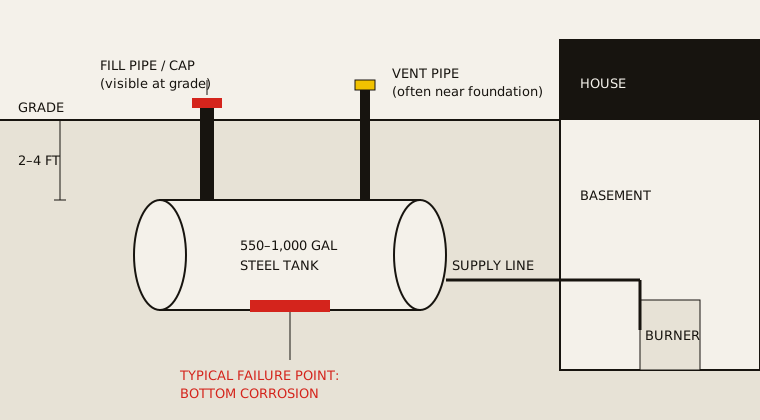
The physical signs, ranked
| Sign | What it means | Confidence |
|---|---|---|
| Fill pipe or cap in the yard, sometimes flush to grade | The port a delivery truck filled the tank through. Directly connected to a tank, present or past. | High — this is tank hardware, not a proxy for it. |
| 1–2" vent pipe near the foundation | The tank's air vent, usually a small pipe with a mushroom cap hugging the foundation wall. | High — vents serve tanks and nothing else. |
| Copper supply lines through the foundation wall | The feed that carried oil from the tank to the burner. Look low on the basement wall on the yard side. | High when paired with either pipe above. |
| Capped lines at the burner or where a burner was | The house burned oil at some point. Says nothing yet about where the tank was — or whether it left. | Medium — confirms oil history, not tank location. |
| Unexplained concrete patch in walkway, patio, or driveway | Possibly a filled fill-pipe hole, or where surface plumbing was cut and buried. | Low alone — patches have many causes. Rises sharply next to a vent pipe. |
| Dead or discolored rectangle of grass | Can indicate disturbed backfill over a tank pit, or a shallow tank affecting drainage and root depth. | Low alone — lawns die for many reasons. A data point, not a finding. |
Two high-confidence signs together — a fill cap plus a vent pipe, or either plus supply lines — make a tank likely enough that the next dollar is better spent on records and a sweep than on further staring at the lawn.
The house-history angle
Age and heating history narrow the odds fast. Most NJ residential tanks went into the ground between the 1940s and 1980s, so a pre-1980s house that ever burned oil should be treated as a candidate until proven otherwise. The classic case is the converted house: it heats with gas today, the listing says gas, the owner says gas — and the conversion crew in 1978 swapped the burner, cut the copper lines, and left the tank exactly where it was. Conversion was a heating job, not an excavation job, and removal was rarely in the scope.
Questions that settle the history: has the house ever had oil delivery (neighbors and long-tenure owners remember trucks); is there an old oil burner, or the footprint of one, in the basement; do the basement walls show capped or cut copper lines. If the house was built after the mid-1980s and always heated with gas, your odds drop toward zero and you can likely stop here — the same honest logic as whether you need to remove a known tank at all.
What property records show
Municipal paper trails vary by town, but three record sets are worth a request:
- Permits for oil burners or tank work. A permit for an oil burner installation implies a tank; a later permit for tank removal or closure tells you the story may already be over — and the closure file tells you how well it ended.
- Fire department records. Some departments kept tank installation or abandonment records independent of the building department.
- Tank registrations. Some towns maintained tank registries; where they exist, they are the fastest answer available.
Coverage is inconsistent — plenty of tanks predate the paperwork, and plenty of paperwork is filed under a prior owner's name. A silent file does not prove absence. But a records request costs little, and when the file does contain a closure certificate with soil results, it can save you the entire exercise.
How tank sweeps work
A tank sweep is a technician walking the property with a magnetometer — an instrument that detects the magnetic signature of a large buried steel mass — sometimes supplemented with ground-penetrating radar, which images what is underground and can distinguish a tank from, say, a boulder or a pipe cluster. Neither method digs anything; a sweep takes about an hour and leaves the yard untouched.
A proper sweep report documents what was scanned, what was detected and where (with the location marked on a sketch or photo), and what was ruled out. That report is a real document: buyers order sweeps near-universally now precisely because the report is evidence either way. At $150–$500, it is the cheapest definitive answer in the whole tank problem — which is why buyers are told to order one before closing rather than take a seller's word.
If the house is pre-1980s, ever burned oil, and any single surface sign is present — book the sweep. The combined cost of guessing wrong in either direction is measured in thousands; the sweep is measured in hundreds.
If the sweep finds a tank
Do not panic-dig. A located tank is a decision, not an emergency — the tank has been there for decades, and the correct next move takes days, not hours:
- Get the records first. Pull the municipal file on the tank now that you know it exists. An old closure permit, a prior test, or a registration changes what you do next.
- Then decide deliberately. Removal, closure-in-place, or — if nothing is forcing your hand — documented monitoring while you wait for a real trigger. The remove-vs-close calculator walks the tradeoff, and the remove-vs-close calculator sequences it against your actual situation: selling, buying, refinancing, or none of the above.
- Price it honestly. A clean removal typically runs $1,500–$3,500; the full driver-by-driver breakdown is in the NJ cost guide.
A found tank that you ignore does not stay found only by you. If the property ever sells, the buyer's sweep — near-universal in NJ — will locate the same tank, and the discovery will happen on the buyer's timeline instead of yours. Knowing about a tank and sitting on it indefinitely converts a controlled decision into a mid-contract one.
Next step
If the signs point to a tank, get the records moving and let the decision tools tell you whether this is a spend-money-now problem or a plan-for-later one.